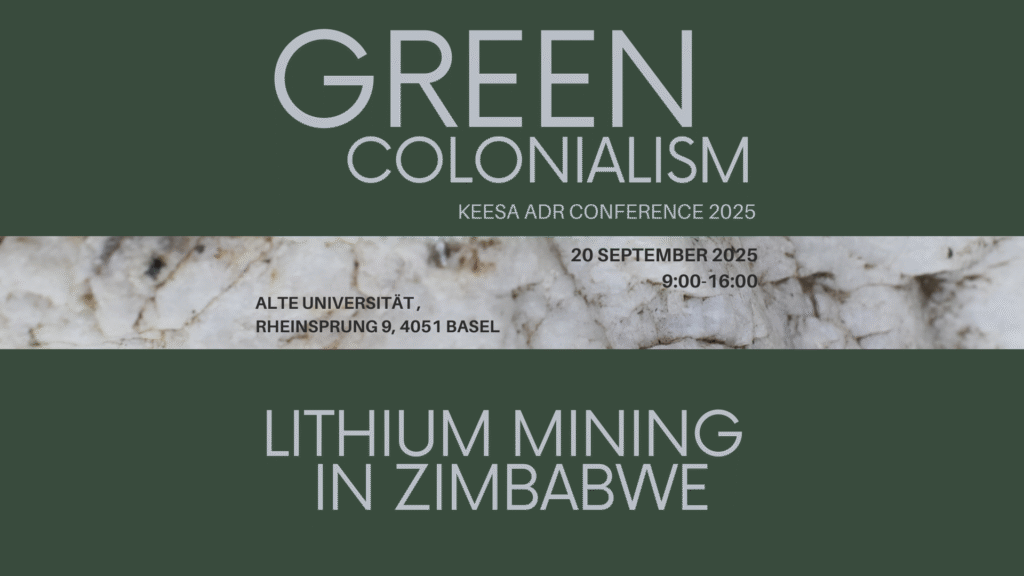
Green Colonialism – Lithium Mining in Zimbabwe
KEESA/Swiss ADR conference September 20, 2025 at the Alte Universität, Basel
Summary
Already today, the negative impacts of climate change affect countries in the Global South most severely. Those countries with the lowest levels of polluting emissions are disproportionately confronted with flooding, cyclones, extreme drought and associated costs. Similar negative consequences arise from the measures pursued by the Global North to curb global warming. These, too, are often borne by resource-rich countries in the South, giving rise to new forms of green colonialism.
One example is the shift towards electric vehicles. Their batteries require large quantities of raw materials such as cobalt, lithium, graphite and manganese. The extraction of these minerals is associated with significant ecological and social impacts. In Zimbabwe, where lithium mining has expanded rapidly in recent years, this has had devastating consequences. Speakers and participants at the KEESA conference last September explored what exactly these consequences mean, and how they should be addressed.
In her opening contribution, Anna-Sophie Hobi (KEESA) argued that the energy transition is dominated by a technology- and profit-oriented approach. The growing demand for lithium, cobalt and rare earths leads to the externalisation of social and ecological costs and reinforces existing political and economic dependencies. The impacts of this model primarily affect poorer, resource-rich countries – in this case, on the African continent.
Using symbolic Shona proverbs, Zacharia Grand (CNRG) offered an in-depth insight into the situation in Zimbabwe. Since 2017, the rapid expansion of lithium mining has led to profound changes, including large-scale land dispossession, social tensions, environmental destruction and the loss of traditional ways of life. Many issues, such as precarious labour conditions, cultural dislocation and a lack of participation, cannot easily be quantified. Grand also pointed out that local elites and weak enforcement of the rule of law facilitate exploitation by international, particularly Chinese, companies. The Shona proverbs illustrated how communities interpret these injustices and articulate resistance.
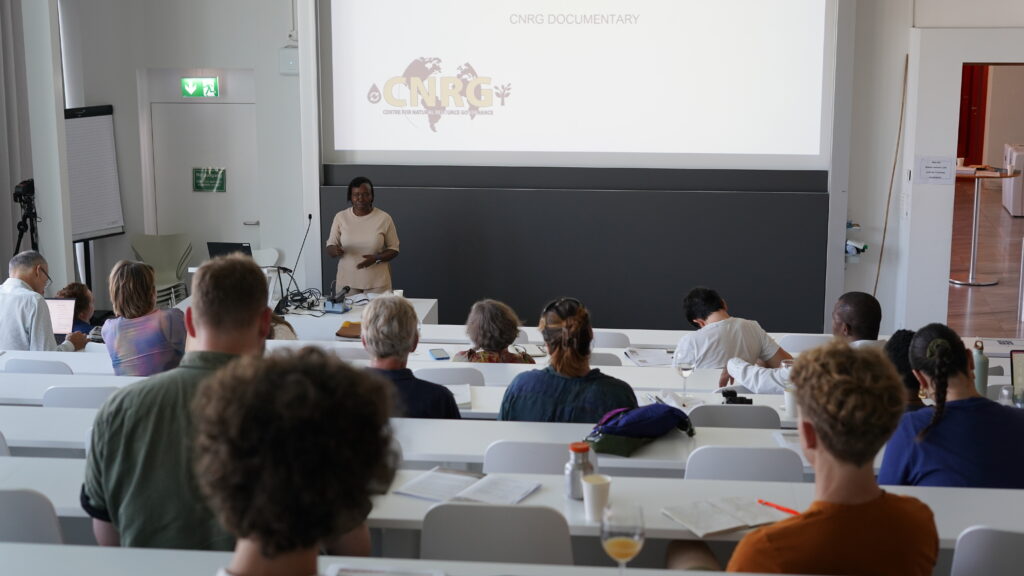
Ndaizivei Garura (CNRG) subsequently presented the work of CNRG. Over recent years, the civil society organisation has documented human rights violations and supports affected communities in claiming their rights and developing non-violent strategies to advance their demands. CNRG trains communities in FPIC principles (Free, Prior and Informed Consent), a right of Indigenous peoples recognised by the United Nations; facilitates dialogue with political actors and companies; and supports communities in legal proceedings. Despite the increasingly restricted space for civil society action in Zimbabwe, the organisation has already achieved concrete improvements, including infrastructure measures in affected regions.
Vanessa Fischer (PowerShift) argued for a just raw-materials transition based on two central pillars: a significant reduction in raw-material consumption in the Global North, and the consistent enforcement of the highest social and environmental standards in extraction and supply chains. Without reducing the enormous consumption of materials and energy, neither effective climate protection nor global justice can be achieved.
During the panel discussion, moderated by Karin Mader, it became clear that bureaucratic business standards alone are insufficient. Systemic change and alternative economic models are required, such as the doughnut economy. Several panellists emphasised the importance of global solidarity, strong civil societies and binding due-diligence obligations in mineral supply chains. At the same time, geopolitical competition, particularly the strong presence of Chinese companies, further intensifies existing challenges.
The conference made one thing clear: lithium mining is more than a side effect of the energy transition. Its consequences reveal systemic inequalities and global power shifts that demand not only binding international standards and the inclusion of affected communities, but also a fundamental questioning of our economic system, extending to a radical reduction of resource consumption in the Global North. Partners from Zimbabwe demonstrated how resistance, creativity and collective resilience can point towards pathways to greater justice, even under difficult conditions.



Photos: Iria Mudimu, 2025